

A strategic partnership to optimise the value of KOC assets
July 8, 2025 Kuwait


Anwar Al Mutlaq, vice-president and country chair for Shell Kuwait, talks to The Energy Year about the company’s strong strategic partnership with KOC and ongoing progress in enhanced technical services agreements. Shell is a global energy company present in Kuwait since 1948.
This interview is featured in The Energy Year Kuwait 2025
Kuwait has announced a KWD 10-billion (USD 32.5-billion) upstream investment plan through 2029, aiming to raise production capacity to 4 million bopd by 2035. In this context, how is Shell supporting KOC in scaling up conventional and heavy oil production?
As of 2024, Shell’s enhanced technical services agreements (ETSAs) with KOC have seen significant progress, focused primarily on strengthening our collaboration in production optimisation and business integration. We have jointly attained the significant production milestone of 90,000 bopd, a historic first from that heavy oil asset in KOC’s portfolio.
The strong performance delivered to reach such a milestone is a testament to the unwavering collaboration and resilience of our amazing teams at Shell and KOC, and the extension of Shell’s role in the ETSAs through 2029.
Leveraging Shell’s technological solutions, KOC aims to enhance production from its northern oil and gas fields, which are central to the country’s 2035 strategic production objectives. Through the ETSA framework, Shell supports the role of digital tools, data analytics and AI in optimising asset performance and extending the life of mature oil fields.
Additionally, Shell and KOC have worked together on enhancing sustainability efforts, with a focus on reducing carbon emissions and exploring CCUS opportunities.
How do you assess the potential of Kuwait’s offshore resources, and what role could Shell play in accelerating their development?
The Al Nokhatha offshore field is a significant milestone for Kuwait’s upstream segment and will be an attractive investment opportunity for IOCs. We were not involved in the recent discoveries; however, Shell has strong experience operating offshore fields, including running an offshore platform using renewable energy in Malaysia. We are happy to share our experiences to support the country’s objectives to progress a successful offshore business.
What role can technology play in unlocking new efficiencies across gas and conventional oil assets in North Kuwait?
Technologies such as Shell Turbo Trays and extended reach drilling are playing a key role in enhancing production efficiency and recovery in North Kuwait’s mature and often technically complex gas and conventional oil fields. A significant milestone for Shell and KOC was the drilling of the longest horizontal well in Kuwait’s Jurassic asset, reaching more than 6 kilometres into the subsurface.
These technologies bring value to the collaboration between KOC and Shell in North Kuwait. Given that the reservoirs are often complex carbonate systems with variable permeability and maturity, they require precision reservoir management and advanced technologies to reach the oil and gas at extreme depths. Such technologies enable higher recovery factors, reduce water production and minimise environmental impact to ensure stronger alignment with KOC’s goals of cost optimisation and sustainability.
In summary, Shell Turbo Trays improve surface facility efficiency, while multilateral wells optimise subsurface access and recovery. Together, they significantly enhance the economic and operational performance of upstream operations in North Kuwait.
Moreover, in the past decade, unmanned aerial systems (UAS) have gone from being a nascent technology to regular sights at Shell locations around the globe. Initial deployments focused on simple one-off inspections, such as for flare tips, but assets have found many new applications for commercial UAS. The evolution has led Shell to develop new technologies and new ways of using these tools.
In the future, machine vision and advanced analytics will help to extend the application space for Shell, thus reducing the risks to human operators and lowering costs compared with traditional inspection and survey practices. At Shell’s Pennsylvania Chemicals facility, drones are used to take snapshots of construction progress and produce dimensionally accurate 3D models from aerial imagery, covering the footprint of the construction site. In Jurassic gas fields, UAS have been tested to monitor fugitive emissions and detect leaks to enhance safety and environmental performance.
How can Shell help sustain and scale Jurassic gas production in line with Kuwait’s plan to reduce LNG imports? Are there new reservoirs or technologies to exploit?
Shell contributes to Jurassic gas output through enhanced gas recovery and subsurface optimisation. With advanced reservoir modelling, we can optimise gas recovery from tight and complex Jurassic formations. Shell has vast experience in hydraulic fracturing, acid stimulation and horizontal drilling to increase gas output per well and extend plateau production.
The Jurassic ETSA teams also focus on gas processing and infrastructure support by designing or fast-tracking modular or expandable gas processing facilities that can address bottlenecks as well as improve sulphur removal and carbon dioxide handling. Moreover, technology transfer and local talent development programmes are key focus areas for Shell to ensure effective support to KOC. We play a role in upskilling Kuwaiti engineers, particularly in unconventional gas and high-pressure sour gas handling.
We have also been very successful in identifying new reservoirs for additional gas. The Najmah and Kerogen reservoirs are a great example of the collaboration between Shell and KOC; new technologies applied to these reservoirs have enabled us to unlock significant volumes and value for KOC.
We are very happy to witness KOC’s efforts and investments in new reservoirs. Kuwait is currently short in gas production and imports a significant volume of LNG. The more gas volumes generated locally, the less LNG will need to be imported into the country. Furthermore, gas is an important feedstock for petrochemicals. We are excited about the recent achievements we made in gas, yet KOC and the Shell teams continue to work jointly to achieve the target of 26.9 mcm (950 mcf) per day in the next few years.
Shell has been involved in cogeneration in heavy oil environments. How feasible is this approach in the South Ratqa and Umm Niqa fields, and what impact could it have on production costs and emissions?
Energy efficiency initiatives within KOC operations are actively designed and implemented across KOC and Shell ETSA teams jointly in North Kuwait fields to improve the energy efficiency of technologies, optimise processes and integrate renewable energy sources to power on-site activities. These efforts not only reduce operational costs but also support Kuwait’s sustainability goals and energy transition strategy.
Shell has been developing a synergy between the Ministry of Electricity & Water & Renewable Energy and KOC through the deployment of cogeneration technology, which aims to increase South Ratqa’s production to 120,000 bopd and to generate an additional 1.2 GW with a 30% reduction in carbon dioxide emissions. Cogeneration technology can also contribute to significantly reducing costs.
What are the most viable decarbonisation technologies Shell is considering for deployment in Kuwait? Are you conducting any pilots or feasibility studies with KOC?
We have recently concluded a pioneering carbon dioxide capture and injection pilot together with KOC’s EOR teams in West Kuwait. Contrary to expectations, the pilot has been remarkably successful, yielding 500,000 barrels over its first year. In the Jurassic Gas ETSA, a project for blue hydrogen, blue ammonia and CCS has been taken to the concept phase with KOC’s teams, and should progress into the FEED phase within the next year.
What are Shell’s expectations for upstream investment in Kuwait in the medium term?
We will continue to focus on the delivery of our agreements across KPC subsidiaries. We will also look at opportunities to grow our collaboration and sustain our position as the partner of choice for the state of Kuwait.
Read our latest insights on:
More content from Kuwait





Quality seismic decisions for Angola
INTERVIEW
Latest news and features



Latest Reports


The Energy Year Oman 2026
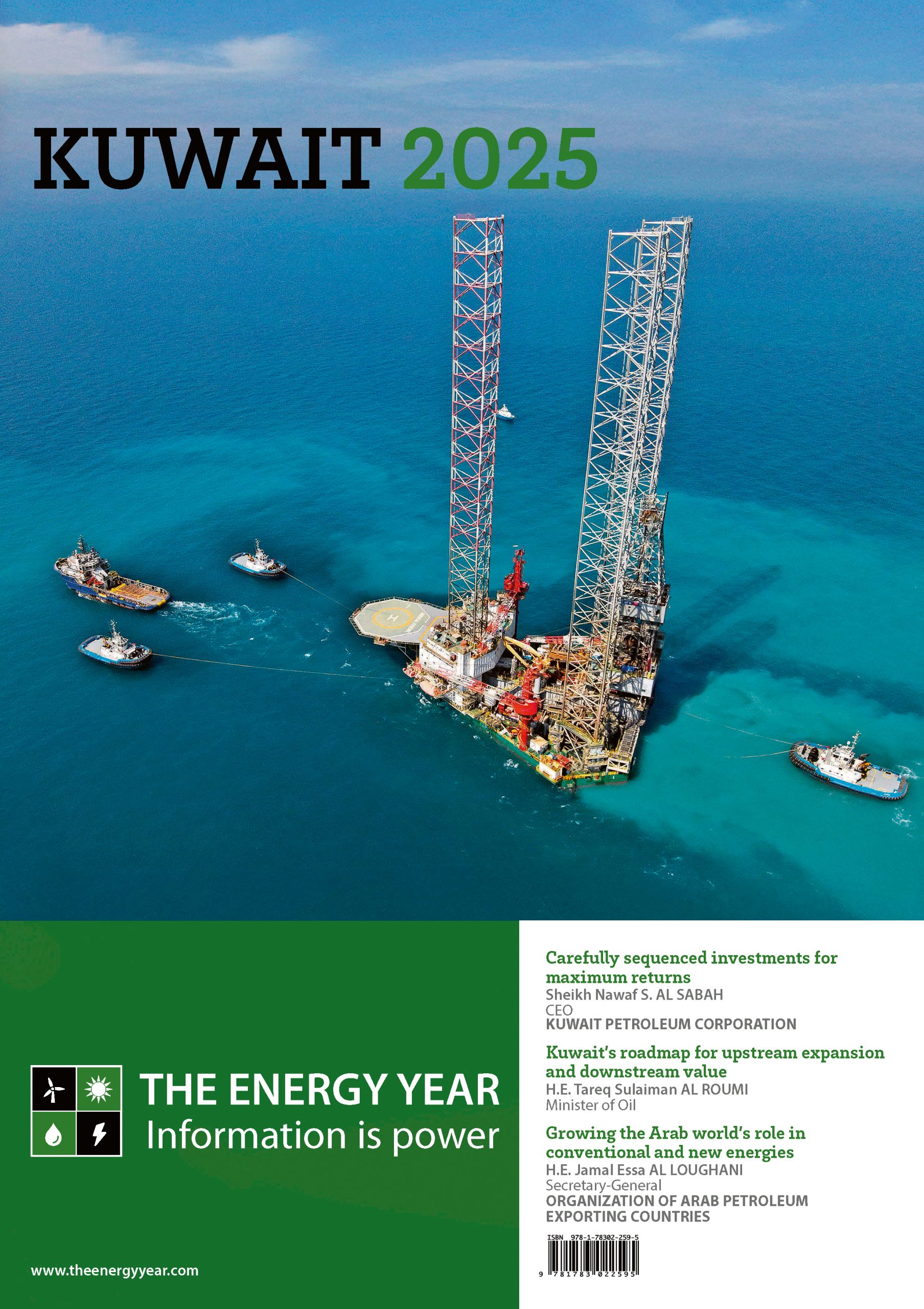
The Energy Year Kuwait 2025
The Energy Year Angola 2025
The Energy Year Nigeria 2025
The Energy Year Saudi Arabia 2025
The Energy Year UAE 2025

