

From data to robotics: engineering the Newrest digital factory
March 20, 2026 Multinational


Newrest’s Digital Factory model represents the industrial expression of its digital ecosystem. By connecting robotics directly to its proprietary ERP system, the group has created intelligent production environments that strengthen traceability, improve predictability and enhance operational efficiency – redefining catering logistics for rail, airline and remote-site environments.
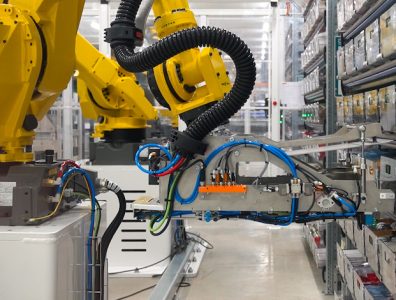
Digital transformation at Newrest moves from architecture to execution within its Digital Factories. These next-generation production units combine robotics, real-time data integration and business intelligence to create structured, high-performance logistics environments.
Rather than standalone automation projects, Digital Factories are designed as fully integrated industrial systems – directly connected to the group’s ERP backbone and aligned with measurable operational objectives.
Robotics integrated with real-time data
At the core of the Digital Factory model is the direct integration between robotic systems and Winrest, Newrest’s proprietary ERP platform.
Production data, stock levels and loading plans are consolidated within the ERP and translated into automated workflows. Robots execute repetitive and physically demanding tasks with precision, while digital monitoring tools ensure traceability at every stage.
Automation supports processes such as drawer identification, re-completion, labelling and loading preparation. Each movement is recorded within the system, reinforcing compliance and reducing variability in output.
The objective is not automation for its own sake. It is engineered predictability – ensuring that production volumes, stock allocation and dispatch flows align precisely with confirmed demand.
A railway production unit re-engineered
The railway Digital Factory in Sucy-en-Brie illustrates how this model operates in practice.
Dedicated to rail catering logistics, the 4,500-square-metre site manages the preparation and re-completion of trolleys for long-distance trains. Each day, up to 500 barsets are supplied through a structured and synchronised workflow.
Robots automatically identify incomplete drawers and direct them to re-completion zones. Once replenished, drawers are stored and prepared for dispatch with automated labelling to ensure precision and full traceability.
Business intelligence tools optimise stock management and anticipate demand variations linked to seasonal peaks or operational events. By synchronising robotics with structured data flows, the unit reduces anomalies, strengthens forecasting accuracy and enhances compliance control.
Automation also improves ergonomics. Heavy lifting and repetitive handling tasks are reduced, allowing teams to focus on supervision, quality assurance and co-ordination – reinforcing both safety and overall performance.
Standardisation at scale
The Digital Factory model follows a consistent design logic across deployments. After earlier implementations in airline catering, including Madrid, the railway unit demonstrates how robotics and ERP integration can be adapted to different mobility environments while maintaining operational coherence.
Each Digital Factory is built around the same principles:
- Direct ERP connectivity
Real-time traceability across production stages
Automated identification and re-completion - Integrated stock optimisation
- Standardised labelling and compliance monitoring
This standardisation enables scalability. As the model expands internationally, processes remain structured and repeatable, reducing implementation risk and strengthening global consistency.
Predictability as a performance driver
In rail and mobility environments, reliability is non-negotiable. Delays or inaccuracies in catering logistics can have immediate operational consequences.
By aligning robotics with real-time operational data, the Digital Factory model strengthens predictability. Production volumes correspond to confirmed demand. Stock levels adjust based on structured insights. Deviations are detected earlier within a controlled digital framework.
Predictability therefore becomes a measurable performance driver – supporting service continuity, reducing operational risk and reinforcing client confidence.
The Digital Factory represents the industrial acceleration layer of Newrest’s broader digital ecosystem. Where the ERP backbone consolidates information and digital platforms enhance engagement, robotics translates structured data into physical execution.
The result is an intelligent production environment engineered for reliability at scale.
Read our latest insights on:
More content from Multinational



Latest news and features






Latest Reports


The Energy Year Oman 2026
The Energy Year Kuwait 2025
The Energy Year Angola 2025

The Energy Year Nigeria 2025
The Energy Year Saudi Arabia 2025
The Energy Year UAE 2025


