

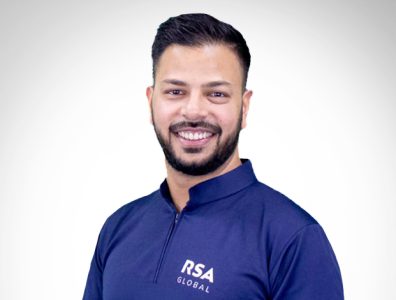
Logistics to support the UAE’s trade priorities
March 5, 2025 UAE
UAE 


Abhishek Shah, co-founder and Group CEO of RSA Global, talks to The Energy Year about establishing joint ventures to bring new transportation and logistics capabilities to the UAE and India, and the company’s ambitions to grow in Saudi Arabia. RSA Global is a UAE-headquartered freight forwarding and supply chain services company that caters to the petrochemicals, automotive, chemicals and oil and gas sectors, among others.
Can you give us an overview of RSA Global’s positioning and strategy?
RSA Global is a 15-year-old, homegrown UAE company. We started in 2009 with the ambition of coupling high-quality infrastructure with great customer service and technology. Fast forward to today, and we have a supply chain organisation that handles air cargo, sea cargo and general cargo logistics, and a significant segment of that is in laydown yard optimisation and out-of-gauge cargo, which touches the oil and gas sector.
We are also involved in petrochemicals and chemicals through our JV with German chemicals logistics specialist Alfred Talke, which handles a whole host of liquid and dry chemicals, many of which are required for extracting or refining oil.
What types of customers do you mostly cater to?
In the petrochemicals and chemicals segments, our customers are chemical manufacturers, distributors, traders and any other companies that have anything to do with the onshore chemicals cycle. Apart from bulk tank farms, we do everything.
We have hundreds of thousands of square meters in our laydown yard for our supply chain business. The majority of it is for finished vehicles, but we also accommodate oil and gas equipment and rigs. Some of our customers are large oil and gas producers, but we don’t work directly with them. We work as subcontractors.
As a smaller business, we don’t see the benefit of going through compliance at their headquarters. Nevertheless, our standards are still very high, because those companies still come in person to audit.
How large is your geographical footprint, and do you have any expansion plans in the Middle East or Africa?
The UAE is our home base and largest market. We continue to invest significant amounts in long-term assets, and we are expanding nearly every single one of our verticals here. However, supply chain solutions is a network game in which you need to cover the origination points and destination points of key markets.
India has a very large domestic market but is also quickly becoming a very important origin of exports to the world. That is why we have been based there since 2018, participating in both domestic movements and export flows. Kenya is another market we know very well, as we do a fair amount of domestic logistics there, but it is mainly a gateway market for East and Central Africa. We are not planning to expand too much in Africa at the moment.
Our goal is to launch operations in Saudi Arabia soon. We have a few customers who are pushing us to extend some of our services there. We are trying to replicate some of the products and services that we have developed in the UAE over the years and push them as a three-city strategy in Saudi Arabia.
What does RSA Global do to distinguish itself from the competition?
Partnerships have been very valuable to us and enabled us to create a service portfolio that our customers value. That’s what has made our approach unique. We love joint ventures. Through them, we can bring competencies to the region that didn’t exist before. We are very happy to share the pie, share the risk and build value. We have two very successful examples in our petrochemicals JV, RSA Talke, and our cold chain JV with Americold.
We contribute knowledge of the market and business practices. We like to join forces with companies that have an appetite to grow business together and share it collectively. That has been at the very core of RSA Global’s growth over the past 15 years.
Do you have any other joint ventures in the pipeline?
We’re always looking for partnerships. We have always been a fairly opportunistic organisation, but over the past five years, we have become more strategic. At the moment, we are looking for various partners in Saudi Arabia.
How do you integrate energy efficiency into your operations?
We consider ourselves early adopters. In 2017, as soon as regulations allowed it in the UAE, we were among the first industrial buildings to install solar. We did this for sustainability purposes and because going green works very well from an economic standpoint as well.
Solar is a big part of our energy efficiency efforts, but now we have integrated IoT devices to monitor our consumption and offset as much as possible. Two of the buildings in our network have become completely net zero thanks to the building design and how we operate.
It is very hard to adopt sustainable practices for our sea- and airfreight solutions, as we cannot dictate what big shipping companies and airlines do. For road transportation, we are testing EVs [electric vehicles] for short hauls and are waiting for charging infrastructure to become more broadly available to implement them on longer trips.
We have also developed a carbon calculator for our customers. Some customers don’t consider it important, but we are seeing more and more customers requiring carbon accounting as part of their RFQs [requests for quotes]. They want to see not only your sustainability strategy but your sustainable initiatives and goals as well.
What is on your to-do list for 2025?
After some years of moderate growth, we are now looking to grow aggressively. In the next five years, we want to become at least two and a half times larger than we are today.
Our number one priority is to service our customers and become a three-market player. We already have India and the UAE, so Saudi Arabia is very important for us to achieve that goal. Secondly, we are opening more sales offices in the US, the UK and Europe, as well as Turkey, for our e-commerce and food transportation businesses because that’s where a lot of cargo originates.
Thirdly, we’re continuing our investment programme in the UAE. We opened a new facility in 2024 and are opening two in 2025.
Read our latest insights on:
-

How the UAE is building its future
INTERVIEW -

-

More content from UAE


Quality seismic decisions for Angola
INTERVIEW
Latest news and features




Latest Reports


The Energy Year Oman 2026
The Energy Year Kuwait 2025
The Energy Year Angola 2025
The Energy Year Nigeria 2025
The Energy Year Saudi Arabia 2025
The Energy Year UAE 2025

