


New field developments push Kuwait to perform
September 18, 2025 Kuwait


Eissa Al Safran, professor of petroleum engineering at Kuwait University, talks to The Energy Year about Kuwait’s prospects for overcoming production challenges onshore and offshore and the role that training and international collaborations can play. Kuwait University is a public teaching and research university that offers undergraduate and graduate degrees.
How do you assess Kuwait’s production capacity targets?
3.2 million bopd is a big leap, but Kuwait has the reservoirs and the capabilities to achieve it. The real challenge, however, isn’t reaching the target; it is sustaining the production rate over a long time. Heavy oil fields are a prime example. They have met production targets in the past, but struggled to maintain them due to issues such as excessive water production, rapid reservoir pressure depletion and sand production.
When KOC aims for 4 million bopd, it might end up producing 8 million barrels of water. That creates complexities, as flow assurance becomes a major technical hurdle due to corrosion, oil-water emulsion, hydrates and other factors that increase costs, require chemical treatment and increase operational risks. Predictive planning and mitigation strategies are vital if KOC wants to achieve and sustain higher production levels.
What is required to sustain higher output over time?
The core issue isn’t always technical; it also comes down to people. KOC needs to better prepare its workforce. This means investing in training and ensuring they understand how to deploy new technologies. For long-term results, Kuwait must invest in R&D to anticipate problems and resolve them before they escalate.
Collaboration is another crucial component. Challenges such as flow assurance have been addressed in offshore fields in the Gulf of Mexico and the North Sea. Kuwait doesn’t need to reinvent the wheel, but rather connect with international experts and adapt their learnings. Innovation, partnerships and foresight should be at the core of KOC’s future strategy.
What role can Kuwait University play in preparing young talent for these future challenges?
Training isn’t something that begins once graduates enter the industry; it starts in the classroom. If faculty are engaged in KOC-led research, the knowledge naturally transfers into course content.
I have done this myself with my work on flow assurance, where I brought the KOC field challenges related to asphaltene deposition into my lectures, case studies and design projects. My research with KOC influenced my teaching significantly, making it more relevant to field applications and challenges.
We also take students into the field for exposure to real-world conditions and communicate with industry professionals to understand their needs. For example, we are designing a training programme for offshore production technology that is grounded in projects and simulations we have developed, and when KOC sends us graduate students, we work with real-world KOC problems, making the learning experience far more relevant.
How do you assess Kuwait’s new offshore discoveries?
The recent offshore discoveries are a significant leap forward for Kuwait. The offshore territory is about one-third of Kuwait’s land mass – roughly 6,000 square kilometres, and the first discovery of Al Nokhatha field east of Failaka Island spans 96 square kilometres and holds an estimated 2.1 billion barrels of light crude, plus 5.1 tcf [144.4 bcm] of associated gas. That’s equivalent to three years of Kuwait’s current oil production.
Initial well tests yielded very promising figures; however, offshore developments are prone to complications, particularly regarding flow assurance. Since offshore processing facilities are limited in space and weight, you often can’t remove all unwanted produced water and gas impurities such as hydrogen sulfide or carbon dioxide.
The produced water and these gas impurities then enter the offshore pipelines and can cause problems such as hydrate formation and corrosion, respectively, particularly in cold underwater temperatures and high-pressure conditions.
These challenges are best handled through flow conditioning, sometimes by lowering the production rate to stabilise multiphase flow. But everything comes at a cost. You may have to install chokes or modify separator pressures to prevent severe slugging, which can otherwise flood your processing equipment if it is not prevented or mitigated.
One can’t avoid these issues entirely, but with proper design and predictive modelling, you can predict, mitigate or manage them. Companies such as BP and Shell have experience in similar offshore settings; thus, knowledge transfer from those companies could help KOC evolve more rapidly.
Do you have an estimate of the timeline KOC needs to develop solid offshore capabilities?
It depends on how quickly KOC can adapt and train its engineers to the offshore technology and environment. The Petroleum Engineering Department at Kuwait University has recently introduced offshore technology courses at both the undergraduate and graduate levels, including multiphase flow modelling, flow assurance, and offshore technology.
However, for this to work optimally, we must advance our faculty’s knowledge through industry-funded research, which would create a cycle of innovation and knowledge transfer.
What is your view on the newly announced Ahmadi Innovation Valley and its role in future energy developments?
Ahmadi Innovation Valley could be a game-changer. Besides R&D, it will be able to offer hands-on training, as it will have a large-scale experimental facility to mimic field conditions, generating data to validate and tune predictive models. International service companies such as Baker Hughes and SLB, as well as IOCs, are planning to open R&D hubs there to offer training to KOC and KGOC [Kuwait Gulf Oil Company] staff.
Which onshore developments would you highlight as the most interesting right now?
Mutraba in North Kuwait is a major development. It is a fractured reservoir with sour gas, which makes it both complex and costly, but it will improve Kuwait’s overall crude quality and diversify its production mix. KOC is shifting from the easy oil in Burgan to more challenging fields, a transition that reflects the country’s broader production strategy.
What role do you see EOR playing in Kuwait’s future production plans?
Kuwait is already utilising steam injection, an EOR method, in the South Ratqa heavy oilfield, transitioning from cold production and cyclic steam stimulation to full-field steam flooding. This presents challenges as produced hot water promotes corrosion and creates flow assurance issues that risk the system integrity.
Consequently, an artificial lift method must be installed to efficiently lift the oil-water mixture. After piloting several artificial lift methods, KOC found that sucker rod pumps are the most suitable for South Ratqa’s field conditions.
Chemical EOR methods, such as polymers and surfactants, are also being piloted, particularly in thin reservoirs such as Umm Niqa. Brownfield developments are targeted for chemical flooding after water flooding reaches its limit. The choice of surfactants or polymers depends on depth, temperature and reservoir properties, so piloting is the key to success.
Read our latest insights on:
More content from Kuwait





Quality seismic decisions for Angola
INTERVIEW
Latest news and features



Latest Reports


The Energy Year Oman 2026
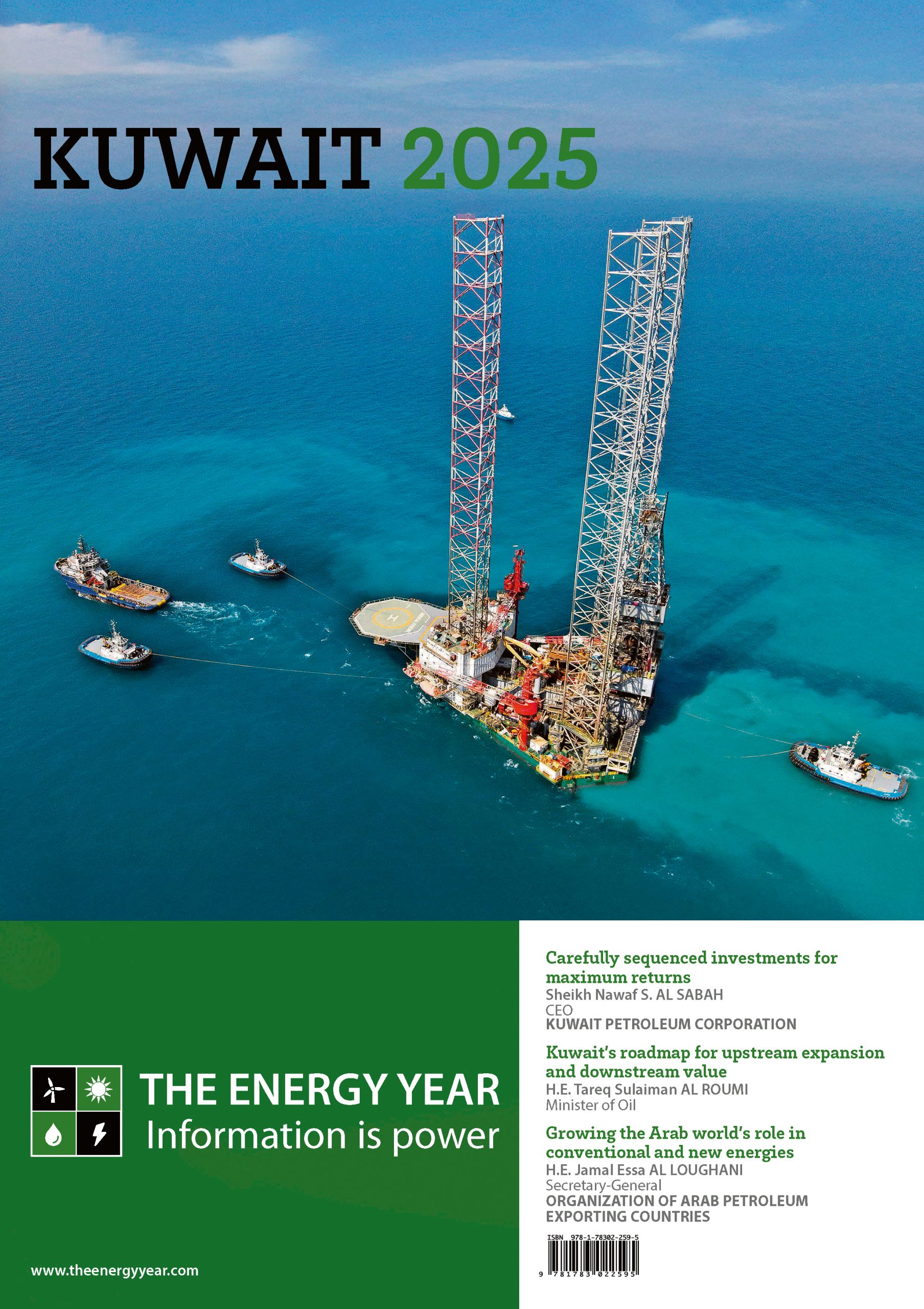
The Energy Year Kuwait 2025
The Energy Year Angola 2025
The Energy Year Nigeria 2025
The Energy Year Saudi Arabia 2025
The Energy Year UAE 2025

