

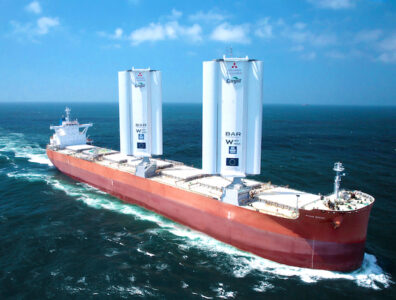
Cargill sees 14% fuel savings on wind-powered cargo ship
 Multinational


MINNEAPOLIS, March 13, 2024 – Cargill has reported the results of a test voyage of a cargo vessel with wind-assisted propulsion, saying on Tuesday that the technology achieved a 14% drop in fuel usage.
The US-headquartered commodities giant plans to roll out the technology on its fleet of dry bulk cargo vessels.
The company’s 80,000-tonne Pyxis Ocean bulk carrier was fitted with WindWings, 37-metre-high sails composed of steel and composite glass developed by the UK’s BAR Technologies.
“We are on the leading edge of change in the shipping industry and believe technologies that harness the wind could be an important, cost-effective way to achieve our decarbonisation goals in the short, medium and long-term,” said Jan Dieleman, president of Cargill’s Ocean Transportation business.
Cargill supplies 125 global markets with food, ingredients, agricultural solutions and industrial products via its fleet of around 570 dry bulk carriers. This includes 180 Panamax, 130 Handysize, 120 Supramax and 120 Capesize vessels, as well as 20 Coasters.
The International Maritime Organization targets a 50% reduction in greenhouse gas emissions from the global shipping industry by 2050. While maintaining that decarbonisation is a “non-linear process,” Cargill has refrained from setting numerical targets but describes its approach as “accelerating the transition to zero-carbon shipping.”
Read our latest insights on:


More content from Multinational





Quality seismic decisions for Angola
INTERVIEW

Latest news and features



Latest Reports



The Energy Year Oman 2026
The Energy Year Kuwait 2025
The Energy Year Angola 2025
The Energy Year Nigeria 2025
The Energy Year Saudi Arabia 2025

The Energy Year UAE 2025

