
in figures
Planned sustainable energy investments under UAE Energy Strategy 2050:Up to USD 54 billion
Projected sustainable investments in the GCC by 2030:Up to USD 2 trillion
UAE government investment in AI ventures in 2024:USD 546 million
Enterprise value of ADNOC's energy investment arm, XRG:More than USD 80 billion
The UAE’s AI-driven green finance transformation
May 30, 2025 UAE
UAE 


In addition to breaking ground on record-breaking energy projects to meet transition targets, the UAE is also fast-tracking initiatives to become a global hub for green finance. ADNOC’s launch of lower-carbon and chemicals investment juggernaut XRG has opened a new chapter in the country’s sustainability agenda.
While hydrocarbons have historically driven the UAE’s economy, the country is gradually emerging as a leader in global energy transition investments. At COP29 in Baku, Azerbaijan, in November 2024, the UAE pavilion hosted eight sessions in collaboration with Abu Dhabi Future Energy Company (Masdar) and the Global Climate Finance Centre to find ways of filling climate finance gaps with improved access to investment funds and position the country among the world’s leading players in green financing.
Among other goals, the UAE seeks to top the charts in the GCC’s anticipated sustainable investments, which are projected to add up to USD 2 trillion to regional GDP by 2030, according to KPMG. As a crucial step in securing the nation’s leadership in sustainability, ADNOC launched XRG in November 2024 as a vehicle to channel the nation’s financial resources into green projects worldwide.
XRG EMERGES: XRG – formerly known as ADNOC International – has been reshaped into a vehicle for investments in low-carbon energy and chemical ventures, and is set to become the cornerstone for the UAE’s green industrial strategy around the globe. With an enterprise value of more than USD 80 billion, the new company has three strategic priorities: becoming a top-five global chemicals player to capitalise on a projected 70% rise in the demand for chemicals and speciality products by 2050, building an integrated gas portfolio to meet a 15% demand increase over the next decade and investing in low-carbon energies and decarbonisation technologies worldwide.
In December 2024, XRG took a major step in expanding its chemicals portfolio by securing a deal to acquire a 91.3% stake in Covestro, one of the world’s leading polymer manufacturers. Looking ahead, the UAE aims to position XRG as its leading platform for driving a global green energy revolution. To do so, the company is also leveraging AI to optimise energy systems, cut emissions and drive the transition to a greener economy. Having begun operations in Q1 2025, XRG aims to present its comprehensive global strategy later in the year.
A SUSTAINABLE POWERHOUSE: The UAE’s push for global green energy leadership is powered by ambitious local initiatives, with major renewable projects already operational or in development. The UAE Energy Strategy 2050, first introduced in 2017 and updated in 2023, aims to triple the country’s renewable energy capacity by 2030, relative to 2022 levels. The strategy includes investments of up to USD 54 billion to sustainably meet growing energy demand, drive research and development in emerging technologies and generate 50,000 new green jobs. In this context, Abu Dhabi Bank, the country’s largest financial institution, had driven USD 58 billion in sustainable investments by end-2024 – meeting 43% of its USD 136 billion target for 2030.
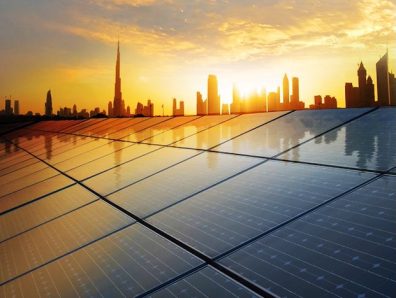
Among the nation’s largest renewables developments is the 1.2-GW Noor Abu Dhabi solar park, which began operations in 2019, and the 2-GW Al Dhafra Solar PV IPP, the world’s largest single-site solar plant upon launch. Located south of Abu Dhabi, the Al Dhafra facility spans 20 square kilometres and comprises more than 4 million PV modules. The power purchase agreement between the Emirates Water and Electricity Company and the EDF Renewables-Jinko Power Consortium set a world-record tariff of USD 0.0135 per kW in 2020, later improved to USD 0.01.32 at financial close. Inaugurated in November 2023, the project now supplies electricity to nearly 200,000 homes and saves an estimated 2.4 million tonnes per year (tpy) of carbon dioxide emissions.
In September 2024, Masdar, alongside partners EDF Renewables and Korea Western Power, secured financial close for the Al Ajban Solar PV project, located 70 kilometres northeast of Abu Dhabi. Backed by six banking institutions, the project will feature 3 million PV modules, generate 1.5 GW of clean electricity and displace more than 2.4 million tpy of carbon dioxide emissions. Construction commenced in November 2024, with completion targeted for Q3 2026.
As part of a COP28 agreement to triple global nuclear capacity by 2050, the UAE is also accelerating its integration of nuclear power to meet base-load electricity demand. The Barakah Nuclear Energy Plant is now the country’s largest electricity supplier and the first operational multi-unit nuclear facility in the Middle East. With the launch of its fourth APR-1400 reactor in September 2024, Barakah now generates 5.6 GW and meets around 25% of the UAE’s total energy demand.
Additionally, aligned with the We the UAE 2031 programme and on the back of its momentous shift towards renewables, the UAE is positioning itself as a global leader in hydrogen production and supply through its National Hydrogen Strategy 2050. The plan aims to produce 1.4 million tpy of hydrogen by 2030, scaling up to 15 million tpy by 2050 through the development of five dedicated hydrogen oases backed by the country’s constellation of state-of-the-art renewables infrastructure.
AI GOES GREEN: The UAE’s goal to become the world leader in artificial intelligence is having a large impact on its energy transition efforts. Since launching the UAE Strategy for Artificial Intelligence in 2017, the country has emerged as a leading contender for leadership in the field, with USD 546 million invested in AI ventures by the state in 2024 alone. The nation’s larger energy players have rapidly adopted AI in their operations, including Dubai Electricity & Water Authority, which began using the technology in 2017 and has since incorporated it into all its services. AI is also being utilised to manage the environmental impact of Abu Dhabi’s urban developments. The six-square-kilometre Masdar City project uses AI to optimise the output of its wind turbines and solar panels and balance its power consumption.
In November 2024, ADNOC unveiled plans to integrate autonomous agentic AI into the energy sector for the first time, partnering with G42, Abu Dhabi-based AI champion AIQ and Microsoft – building on Microsoft’s USD 1.5-billion investment in the UAE’s premier AI holding company G42 in April 2024. AI also took centre stage at the World Future Energy Summit 2025 in Abu Dhabi, where industry leaders showcased its potential to advance renewables and optimise their contributions to the energy mix by forecasting weather patterns to predict energy demand, optimise grid management and reduce wasted energy and its associated costs.
GLOBAL GAS EXPORTER: Amid its accelerated integration of low-carbon energy sources, the UAE is expanding its gas production capacity to meet a projected 6% increase in domestic gas demand by 2030 and a 70% surge in global LNG demand between 2024 and 2050. “While we are seeing a strong uptake of renewables across the region, natural gas is expected to be the most prevalent energy source,” Obaid Abdulla Al Dhaheri, CEO of Dolphin Energy, told The Energy Year. “According to the Gas Exporting Countries Forum (GECF), gas demand in the Middle East is expected to rise by 1.5% per year to reach 855 bcm [30.2 tcf] by 2050.” In November 2024, ADNOC Gas raised its capital expenditure target to USD 15 billion by 2029, up from the previously allocated USD 13 billion, reinforcing its commitment to energy security and market expansion.
At the heart of the UAE’s gas strategy is the Hail and Gasha project, located on the offshore Ghasha concession. In partnership with Eni, Lukoil and OMV, ADNOC is aiming to commence production at the play by 2028. A key objective of the project is achieving net-zero carbon emissions, supported by Germany’s Linde Engineering, which was selected in October 2024 to provide its proprietary carbon capture technology.
The UAE is also advancing its gas ambitions with the upcoming Ruwais LNG facility in Al Ruwais Industrial City, located in Abu Dhabi’s Al Dhafra region. The plant will feature two trains with a combined capacity of 9.6 million tpy, more than doubling the country’s LNG output to approximately 15 million tpy. Set to be the first LNG export facility in the Middle East and North Africa powered entirely by clean energy, the project underscores the UAE’s commitment to sustainable energy expansion.
Read our latest insights on:
-

How the UAE is building its future
INTERVIEW -

-

More content from UAE


Quality seismic decisions for Angola
INTERVIEW
Latest news and features



Latest Reports


The Energy Year Oman 2026
The Energy Year Kuwait 2025
The Energy Year Angola 2025
The Energy Year Nigeria 2025
The Energy Year Saudi Arabia 2025
The Energy Year UAE 2025

